Setlists and Charts on a Tablet: Going Paperless for Gigs
In 2026, many working musicians have swapped the sweaty stack of printed charts for a single tablet that holds an entire night’s material. The shift isn’t about chasing the latest gadget; it’s about reliability under stage lights, quick page turns between songs, and never again watching sheet music slide off a music stand mid-set. With the right offline habits, a tablet becomes a calm, predictable partner even when the venue Wi-Fi is nonexistent and the house lights are blinding.
Preparation starts long before soundcheck. Convert every chart, lyric sheet, and chord diagram into a PDF or image file and store it directly on the tablet. Download everything to local storage so the device never needs internet once you leave the house. Create one master folder for the current gig and a separate archive folder for older repertoire. This simple structure prevents frantic scrolling when the bandleader calls an audible.
Screen Settings That Survive the Stage
Stage lighting changes fast. Set screen brightness to a fixed 65–75 percent before the first downbeat; auto-brightness usually overreacts to spotlights and leaves charts either washed out or too dim. Switch to a dark background with light text—cream or pale yellow on deep charcoal works best under colored lights. Increase font size so chord symbols remain readable from arm’s length. Disable auto-lock entirely during the performance window; a tablet that sleeps between songs is worse than paper. Turn off all notifications and switch to airplane mode to eliminate pop-ups and battery drain.
Building a Reliable Set Flow
Arrange songs in fixed performance order inside a single scrolling document or a dedicated playlist-style viewer. One-tap advance should move you to the next tune without hunting through folders. Many players keep the full set in one long vertical file with clear dividers between songs; others prefer individual pages that flip forward with a single gesture. Either method beats flipping through a binder when the crowd is loud and the setlist is changing.
Page turns are the moment where tablets shine or fail. A simple footswitch connected wirelessly lets you keep both hands on your instrument. If wireless gear isn’t practical, a bandmate can swipe from the side of the stage, or you can rehearse a quick thumb gesture between chords. Practice the motion under gig conditions so it becomes automatic.
- Always carry a phone with the identical set loaded as a backup; a quick Bluetooth transfer or cloud sync before leaving home keeps both devices in sync.
- Rehearse the entire set on the tablet at least twice before the first show so muscle memory matches the screen layout.
- Label each chart with key, tempo, and the next song title at the bottom so you can call the set on the fly.
Paper Versus Tablet Trade-offs
| Factor | Paper Charts | Tablet Setup |
|---|---|---|
| Weight on stage | Typical 1–3 kg binder | Under 0.7 kg total |
| Lighting adaptability | Needs separate stand light | Screen brightness 65–85 % range |
| Page turn speed | 2–4 seconds manual flip | Under 1 second with footswitch |
| Backup reliability | Physically durable but can be lost | Phone mirror + cloud copy |
| Weather vulnerability | High (rain, sweat, wind) | Low if device is in protective case |
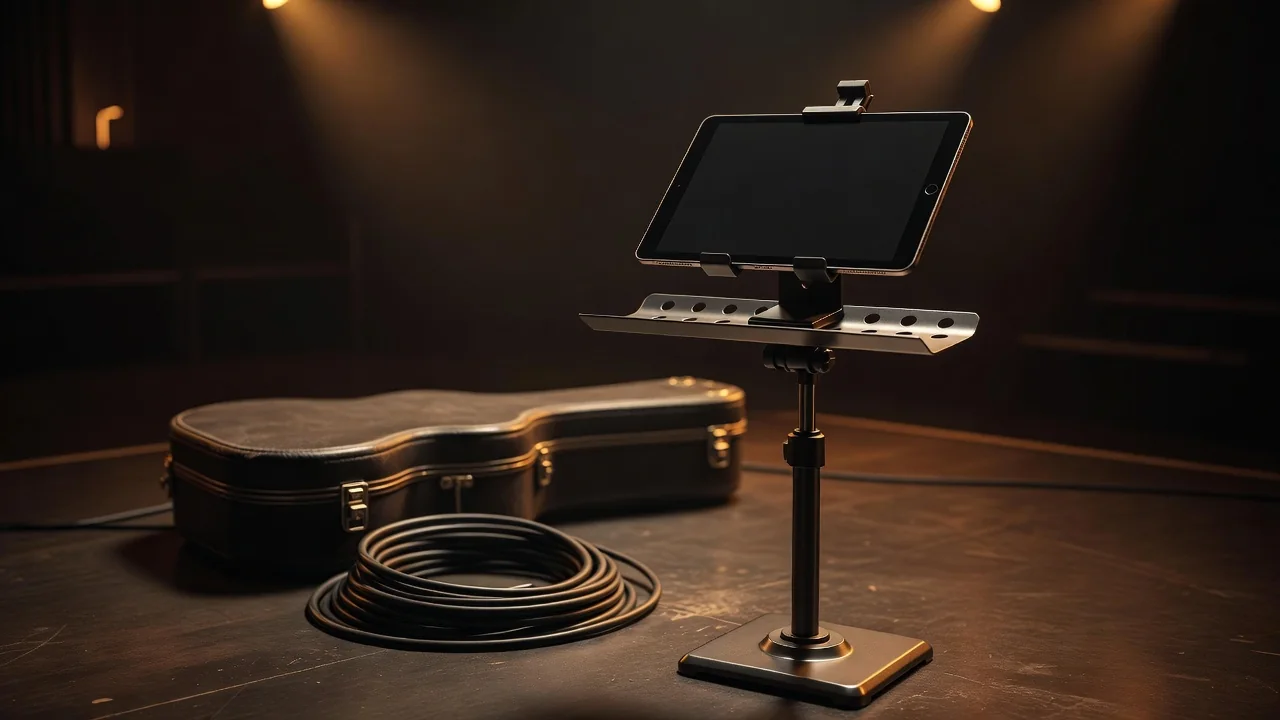
Real gigs reveal the practical details. Arrive with the tablet at 85 percent charge and a short USB cable in your bag. Place the device on a low-profile stand angled slightly toward you so reflections don’t blind the audience. If the stage is outdoors, a clear waterproof sleeve protects against sudden drizzle without dulling the screen. Between sets, lock the tablet in its case rather than leaving it exposed on the keyboard.
The transition from paper to tablet rewards rehearsal more than it rewards money. Once the set order is locked, the screen brightness is dialed in, and the footswitch feels natural, the stage feels lighter. You glance down, see exactly what you need, tap once, and keep playing. The music flows without the rustle of paper or the panic of a missing chart. In 2026, that quiet confidence is what separates a smooth gig from one that fights you the whole night.